November 4, 2026 · 11 min read · AI agents · Architecture · Production
The AI Agent Mind Map: From Idea to Production
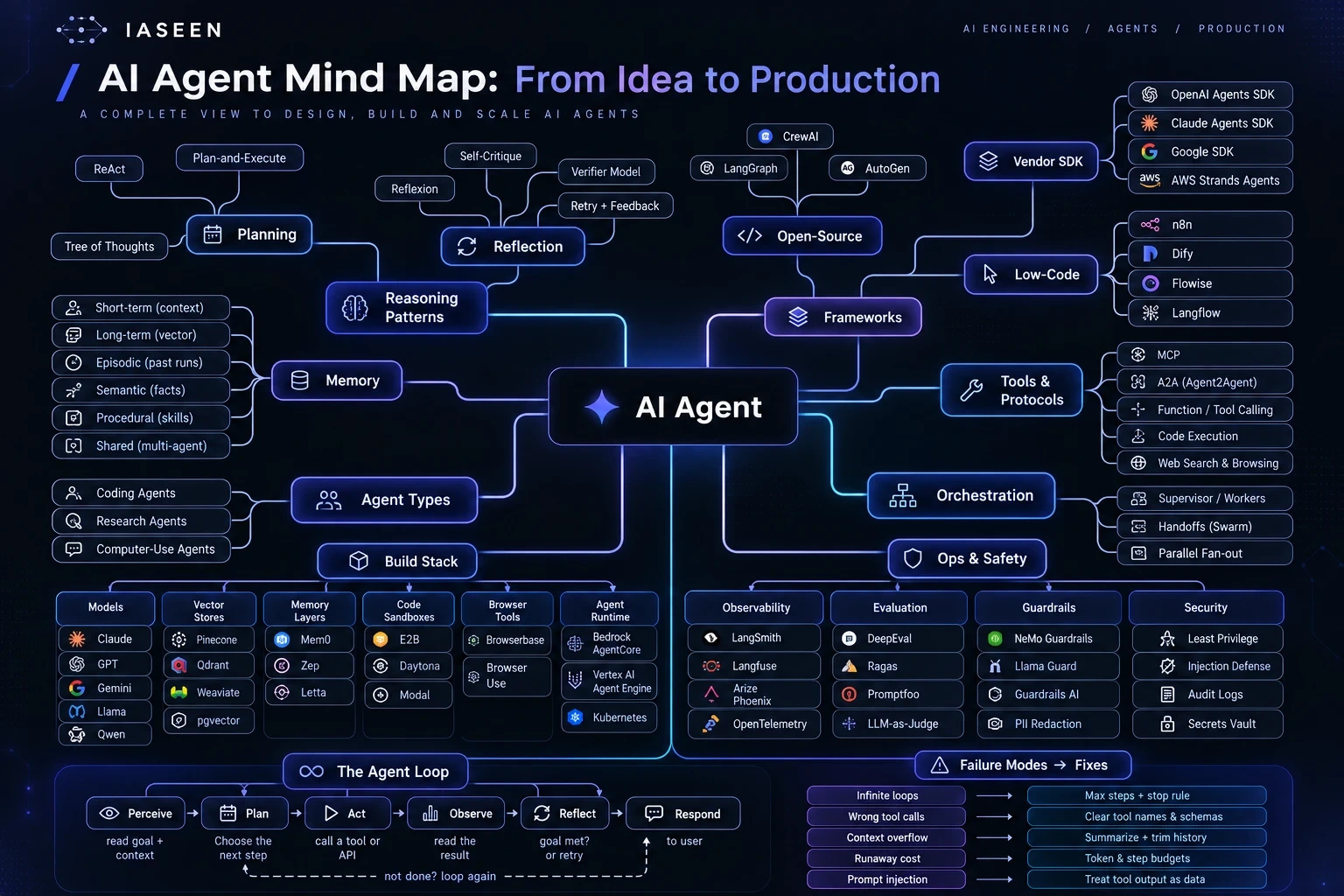
One page that shows every decision between an agent idea and an agent in production: reasoning, memory, tools, orchestration, stack and safety, with the failure modes each one invites.
Yassine Aqejjaj · HEAD OF AI · Updated on November 4, 2026
An AI agent is a model running in a loop: perceive, plan, act, observe, reflect, respond. Taking it to production means making eight decisions around that loop: reasoning pattern, memory, agent type, framework, tools, orchestration, build stack, and operations and safety. This map lays them out, with the failure modes each one invites.
What is an AI agent, and what does this map cover?
An agent is a language model placed in a loop and given tools. Instead of answering once, it reads a goal, decides what to do, calls a tool, looks at the result and decides again, until it judges the task done or a rule stops it. That loop is the bottom row of the map. Everything else is a decision you make around it.
The map answers the two questions every team asks: where do we start, and what are we forgetting? The centre is the agent. Around it sit eight branches, each one a family of choices. Reading clockwise from the top left: reasoning patterns, memory, agent types, build stack, operations and safety, orchestration, tools and protocols, and frameworks. At the very bottom, a table pairs five common failures with the fix that works.
- Perceive
- Plan
- Act
- Observe
- Reflect
- Respond
What happens inside the agent loop?
The loop has six stages, and each can fail in its own way. Naming them is useful because it tells you where to put a log line, a limit or a test.
- Perceive: read the goal and the context. Failure here is a missing or oversized context.
- Plan: choose the next step. Failure here is a plan that does not fit the tools you gave it.
- Act: call a tool or an API. Failure here is the wrong tool or the wrong arguments.
- Observe: read the result. Failure here is trusting a result that was empty, wrong or hostile.
- Reflect: ask whether the goal is met or whether to retry. Failure here is looping without progress.
- Respond: answer the user. Failure here is an answer that sounds finished when the work is not.
Which reasoning pattern should you choose?
The map splits reasoning in two. Planning covers ReAct, Plan-and-Execute and Tree of Thoughts. Reflection covers Reflexion, Self-Critique, a separate verifier model, and Retry with Feedback.
My rule of thumb is to start with the simplest pattern that works and add structure only when a failure demands it. ReAct, where the model alternates between thinking and acting, is enough for many tasks. Plan-and-Execute earns its place on long tasks, because writing the whole plan first makes drift visible. Tree of Thoughts is rarely worth its cost outside hard search problems.
Reflection is where teams often overspend. Asking a model to critique its own answer costs tokens and often agrees with itself. For anything with consequences I prefer a check that does not share the generator's blind spots: a verifier model, a rule, or a test.
What kinds of memory does an agent need?
The map lists six, and they answer different questions. It helps to ask what the agent must remember and for how long before choosing a store.
- Short-term memory is the context window: the current task, nothing more.
- Long-term memory sits in a vector store, for knowledge worth retrieving later.
- Episodic memory records past runs, so the agent can learn from what happened.
- Semantic memory holds stable facts about users and the domain.
- Procedural memory holds skills: how to do something, reusable across tasks.
- Shared memory lets several agents read and write the same state.
Why does memory need governance, not just storage?
Most memory problems are not storage problems. They are trust problems: where did this fact come from, is it still true, and who is allowed to see it? A memory that cannot answer those questions will eventually put a stale or private fact into a prompt.
That is the idea behind ORBIT, the governed context and memory engine I build: context should be traceable and time-aware, especially across long-running and multi-agent work. Whatever store you choose, store provenance and a date next to the content, and decide in advance what may be forgotten.
Which type of agent are you building?
The map names three: coding agents, research agents and computer-use agents. They differ less in intelligence than in how much damage a wrong action can do. A research agent reads. A coding agent writes files and runs commands. A computer-use agent clicks around real applications, which is the widest action surface of the three.
Choose the type first, because it sets how much sandboxing, review and approval you need later. I wrote about the coding-agent case in my article on earned autonomy: autonomy should be granted step by step, as evidence builds up.
Open-source framework, vendor SDK or low-code?
Frameworks are the branch with the most logos, so it is the easiest to get lost in. Think in three families: open-source frameworks such as LangGraph, CrewAI and AutoGen; vendor SDKs from model providers and cloud platforms; and low-code builders such as n8n, Dify, Flowise and Langflow. The table below is my own simplification, not a benchmark.
| Criterion | Open-source framework | Vendor SDK | Low-code builder |
|---|---|---|---|
| Control over behaviour | High: you own the graph | Medium: you follow the vendor's model | Low to medium: you configure blocks |
| Speed to a first prototype | Medium | High, when you already use that vendor | Highest |
| Switching cost | Medium: code is yours, patterns are shared | High: concepts and tracing are vendor specific | High: flows live in the tool |
| Who can build | Engineers | Engineers | Engineers and technical business users |
| Best fit | Custom, long-lived platforms | Teams standardised on one provider | Internal automations and quick experiments |
How do tools and protocols connect an agent to the world?
An agent is only as capable as the tools it can call. The map groups them as function or tool calling, code execution, web search and browsing, and two protocols: MCP, which standardises how an agent reaches tools and data, and A2A, which standardises how agents talk to one another.
Two practical points. First, a tool description is part of your prompt: clear names and strict schemas prevent a whole class of wrong calls. Second, code execution and browsing belong in a sandbox, never on the machine that holds your secrets. Protocols reduce integration work, but they do not decide what an agent is allowed to do. That is a policy question, and it needs its own layer.
How do you orchestrate several agents?
The map shows three patterns: a supervisor that delegates to workers, handoffs where one agent passes the task to another, and parallel fan-out where several agents work at once and results are merged.
My advice is the same as for any distributed system: do not split a problem across agents until one agent has clearly failed at it. Each extra agent adds coordination, cost and new ways to fail. When the split is justified, a supervisor is the easiest pattern to reason about and to trace.
What goes into the build stack?
The stack branch lists six layers: models (Claude, GPT, Gemini, Llama, Qwen), vector stores (Pinecone, Qdrant, Weaviate, pgvector), memory layers (Mem0, Zep, Letta), code sandboxes (E2B, Daytona, Modal), browser tools (Browserbase, Browser Use) and an agent runtime (cloud agent platforms, or Kubernetes if you run your own).
Two choices deserve care. Keep the model behind an interface, so changing provider is a configuration change and not a rewrite. And treat the runtime as a product decision: it decides how you deploy, scale, isolate and observe agents.
How do you operate an agent safely?
The operations branch has four layers, and teams often build them in the wrong order. They start with guardrails and add evaluation late. I would reverse that.
- Observability: traces of every step and tool call, with tools such as LangSmith, Langfuse, Arize Phoenix and OpenTelemetry. You cannot fix what you cannot replay.
- Evaluation: a fixed set of tasks scored automatically, with tools such as DeepEval, Ragas and Promptfoo, or an LLM used as judge. This is what lets you change a prompt without fear.
- Guardrails: input and output checks, such as NeMo Guardrails, Llama Guard, Guardrails AI and PII redaction.
- Security: least privilege, defence against prompt injection, audit logs and a secrets vault. This layer decides what the agent may do, however well it behaves.
Which failure modes should you plan for?
The table at the bottom of the map pairs five failures with a fix. I added a third column, because a fix only helps if you notice the failure early.
| Failure mode | Fix from the map | How to catch it early |
|---|---|---|
| Infinite loops | Max steps and a stop rule | Alert on runs that reach the step limit |
| Wrong tool calls | Clear tool names and schemas | Track the tool-call error rate in traces |
| Context overflow | Summarise and trim history | Log tokens per step and watch the trend |
| Runaway cost | Token and step budgets | Cost per run, with an alert on outliers |
| Prompt injection | Treat tool output as data, never as instructions | Include injection cases in the evaluation set |
In what order would I build it?
The map shows the whole territory. It does not tell you the order, and order is where projects are won. This is the sequence I would follow today.
- Write the task and the stop rule first: what is done, and when must the agent give up.
- Build one agent with two or three tools and tracing from day one.
- Create the evaluation set before adding features, so every change is measured.
- Add memory only when a measured failure needs it, and give it provenance.
- Add guardrails, permissions and approvals in proportion to the action surface.
- Add orchestration last, and only when a single agent has clearly hit its limit.
FREQUENTLY ASKED QUESTIONS
What is an AI agent?
An AI agent is a language model run in a loop with access to tools. It reads a goal, decides what to do, calls a tool, observes the result and repeats until the task is done or a stop rule ends the run.
What are the stages of the agent loop?
Perceive, plan, act, observe, reflect and respond. If the task is not done, the agent loops again. Each stage can fail differently, so each should have its own logging, limits and tests.
What is the difference between MCP and A2A?
MCP standardises how an agent connects to tools and data. A2A standardises how agents communicate with each other. Neither decides what an agent is allowed to do: that needs a separate policy and permission layer.
How do you stop an AI agent from looping forever?
Set a maximum number of steps and an explicit stop rule, add token and cost budgets, and alert on runs that hit the limit. Reflection should be checked by something that does not share the generator's blind spots.
Should you start with a multi-agent system?
No. Start with one agent and a few tools, measure where it fails, and split into several agents only when a single agent has clearly reached its limit. Every extra agent adds coordination cost and new failure modes.
RESULTS
8
decisions around the loop, from reasoning to operations
6
stages in the agent loop
4
operations layers: observability, evaluation, guardrails, security
5
recurring failure modes, each paired with a fix
THE CODE
KEEP READING
Figures come from validated client results and from my role at Devoteam. The projects on GitHub are public betas.