November 24, 2026 · 10 min read · Agentic AI · Architecture · Production
The Agent Harness: You Own the Loop, the Vendor Ships the Model
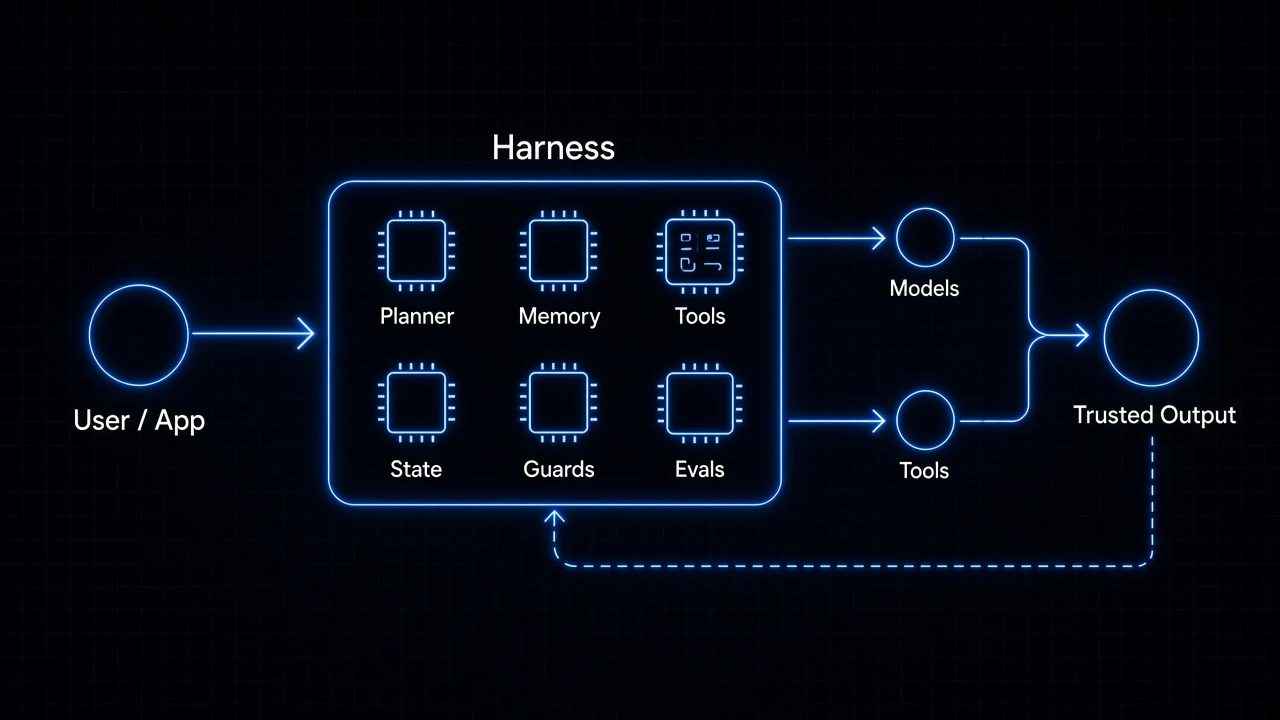
A model is a component. The harness is the product around it: planner, memory, tools, state, guardrails and evals. If you cannot name those parts, you do not own the loop — you are renting a demo.
Yassine Aqejjaj · HEAD OF AI · Updated on November 24, 2026
An agent harness is the layer you own around a model: the planner, the memory, the tools, the state, the guardrails and the evals. The vendor ships a model. You ship a loop that can stop, leave a trace, and be compared to last week. If those parts live only in a notebook, you do not yet have a product.
What is a harness, if the model is not the product?
I have already argued that the loop is the product. The harness is how you build that loop so it survives a change of model, a new tool, and a new person on call. It is the software around the call: how a task is planned, what is remembered, which tools may be used, how state is kept, what is blocked, and how a version is tested.
Teams often discover they have no harness when a vendor updates a model and everything moves. The prompt was in a chat. The tools were wired by hand. The stop rule was “it looked done.” A harness is what remains when you swap the model and still recognise the product.
Which parts belong in the harness, and which do not?
Planner, memory, tool access, state, guardrails and evals belong inside. So does the trace format that makes a run replayable. The model does not. The model is a dependency you should be able to replace, even if you choose not to replace it every week.
I would also keep policy decisions close, but not confused with the filter that enforces them. The harness is the place where those parts meet: a plan may not call a denied tool, a memory may not hold what the policy forbids, an eval may not ship a version that fails a safety case. The meeting is the point. A pile of libraries is not a harness.
| Part | What I expect | What I refuse to outsource |
|---|---|---|
| Planner and stop rule | A named way to decide the next step, and when to stop | The stop rule itself |
| Memory and state | What is kept between turns, and what is discarded | A store I cannot inspect or redact |
| Tools | An allow-list, with identity and a receipt | The decision of which tools may be called |
| Guardrails | Filters on the path, with a log of every block | A silent rewrite nobody can see |
| Evals and traces | A quiz that can block a release, and a run I can replay | The threshold, and the trail that explains a failure |
Why does owning the harness matter more in 2027 than picking a model?
Models will keep changing. A team that can swap a model, rerun an eval set, and keep the same stop rules and traces will move with them. A team that hard-wired last quarter’s model into a notebook will spend the year renegotiating a demo.
This is also why a gateway is not a harness. A gateway can route and cap spend. It does not plan, remember, or decide when the loop is done. And a framework is not automatically a harness. A framework can help you assemble the parts. You still have to name them, test them, and own the release.
How do the other eight ideas sit inside the harness?
The loop is the runtime behaviour. MCP is how tools present themselves at the act and observe stages. Subagents are a way to split work when one context is not enough. A gateway is the door to models. Inference economics is the budget on every turn. Evals are the ship-or-no-ship quiz. Guardrails are the filters on the path. Observability is how you see and replay a run.
The harness is the thing that holds them together. If you treat each idea as a separate purchase, you will have a protocol, a dashboard, a filter and a model card that do not share a run identifier. I would rather have a modest harness where those parts meet than a rich catalogue that never quite connects.
What should you refuse to outsource?
You can rent a model, a vector store, even a set of connectors. I would not rent the stop rule, the allow-list of tools, the eval threshold, or the trace that explains a failure. Those are how you stay accountable when the vendor changes its mind.
I would also refuse a harness I cannot inspect. If a platform hides the prompt that was sent, the tool arguments, or the reason a turn continued, you are not owning the loop. You are subscribing to someone else’s. That can be fine for a trial. It is a poor place to put a decision that affects a customer.
What I measured on a platform that behaved like a harness
On NOVA I have published a 92 percent task-success rate, a 42 percent reduction in execution time, and a platform used by 800 users. Those figures measure the platform, not a harness library in isolation, and I will not relabel them. They are here because the work had the shape of a harness: a loop you can run, tools you can name, and results you can inspect.
I have also written a map of the path from idea to production, and compared orchestration frameworks. This article is not another map, and not another framework review. It is the claim that sits under both: the reusable object is the loop and the software that holds it, not the model of the month.
How should you start building one without boiling the ocean?
Take one loop that already does useful work. Write down the plan step, the memory it needs, the tools it may call, the state it must keep, the filters on the path, and the cases that can block a release. Give every run an identifier. Put those parts in one place you can test.
Do not start by building a platform for every team in the company. A harness that serves one loop well is a product. A platform sketch that serves none is a slide. You can open it to a second loop once the first one has a stop rule, a quiz and a trace you would show a sceptic.
Where do public building blocks like TrustRail and agentic-sdlc fit?
They are parts, not the whole harness. TrustRail is a control plane for agent actions — whether a tool may be called, under which policy, with a receipt. The public demo is at trustrail-mu.vercel.app. Agentic-sdlc is a way to structure the path from intent to working software. Neither replaces a planner, a memory or an eval set.
I mention them because a harness should be allowed to use public parts where they fit, and still remain yours. The test is simple. If you removed that part tomorrow, could you still name the stop rule, rerun the quiz, and read the last run? If not, the part has become the product, and you have lost the loop.
What does a good harness change in the conversation with the business?
It changes the unit of discussion. People stop asking which model you picked, and start asking whether this version of the loop cleared the bar, at what cost, with which tools, and with which stop reason. That is a conversation you can have again next month, after the model has changed.
It also changes who can operate the system. A harness with a trace and a quiz can be handed to someone who was not in the room when the prompt was written. A notebook cannot. If only the author can rerun the work, you do not have a harness. You have a craft project.
What does swapping a model look like when the harness is real?
You change the dependency, you rerun the eval set, you compare cost and latency on the same cases, and you keep the stop rule, the tool allow-list and the traces. If the new model fails a safety case or blows the budget, you do not ship it. If it holds, you have a result you can explain without rewriting the product.
That is the test I would use on any platform that claims to be a harness. If a model change forces you to rewrite the prompt in a notebook, rediscover the tools, and lose last week’s traces, you were renting a demo. A real harness makes the swap ordinary, even when you choose not to do it often.
FREQUENTLY ASKED QUESTIONS
Is a framework the same thing as a harness?
No. A framework can help you assemble planner, tools and state. A harness is the assembled product you own: the stop rule, the allow-list, the eval, the trace, the release. You can build a harness with a framework, or without one. Buying a framework does not finish the work.
Can I change models if I have a harness?
That is one of the points. If the prompt, the tools, the stop rule and the quiz live outside the model, you can swap a model and rerun the set. If they live only in a vendor notebook, a model change is a rewrite.
Where should I start if I only have a demo?
Name the loop: how it plans, what it may call, when it stops, how you will test the next version, and how you will replay a run. Put those parts in one place. Do not start by building a company-wide platform. Make one loop you would show a sceptic.
How does this relate to the AI agent mind map on this site?
The mind map is the path from idea to production, and the vocabulary along that path. This article is the claim underneath: the reusable object is the harness that holds the loop, not the model of the month. Read the map for the landscape. Read this when you need to decide what to own.
Is TrustRail a complete harness?
No. TrustRail is a control plane for agent actions, with a public demo at trustrail-mu.vercel.app. It can sit inside a harness as the decision layer on tools. It does not replace memory, planning or evals. A good harness is allowed to use parts. It should not disappear into one of them.
RESULTS
800
NOVA users on a platform with the shape of a harness
92%
NOVA task success — a platform result, not a library score
−42%
NOVA execution time — inspectable work, not an isolated harness KPI
THE CODE
KEEP READING
Figures come from validated client results and from my role at Devoteam. The projects on GitHub are public betas.