November 24, 2026 · 10 min read · MCP · Agentic AI · Architecture
MCP: One Interface, Many Tools — What the Protocol Does and What It Does Not
The Model Context Protocol makes it easier for an agent to call many tools the same way. That is a design gift. It is not a permission system, and it does not decide what the agent may see or do.
Yassine Aqejjaj · HEAD OF AI · Updated on November 24, 2026
The Model Context Protocol is a standard interface between an AI agent and the tools it calls. A server exposes capabilities, and the agent discovers and uses them the same way, instead of a custom integration for every pairing. In production, MCP makes connection easier; it does not decide what the agent may see or do.
What is the Model Context Protocol?
MCP is a standard way for an agent to discover and call tools. A server publishes what it can do — search a workspace, read a ticket, list files — and a client inside the agent uses those capabilities through one interface. The point is not a new kind of intelligence. The point is to stop writing a bespoke connector for every pair of agent and system.
That sounds like plumbing, and it is. Plumbing matters the moment an agent is in a loop: each turn may call a different tool, and a loop that cannot call tools the same way becomes a pile of special cases. I wrote about that loop — plan, act, observe, reflect — in my article on agentic loops. MCP lives mainly in the act and observe stages: it is how the action is issued, and how the result comes back.
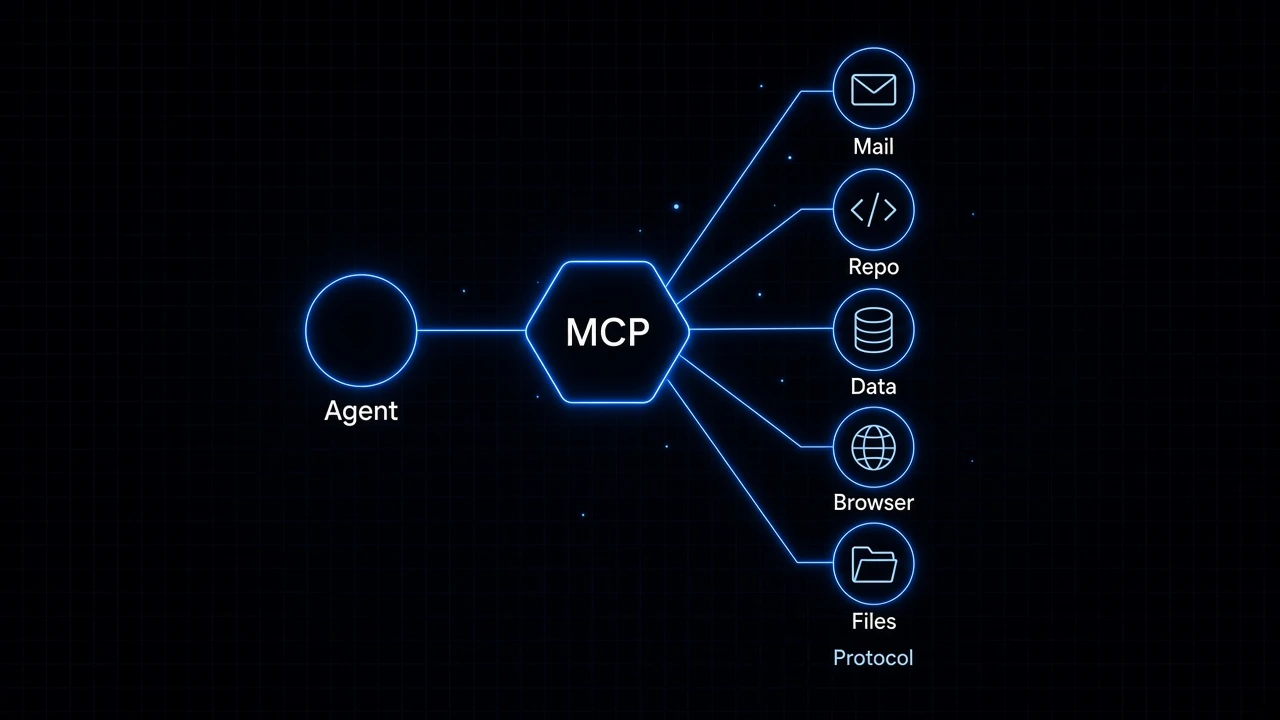
- Agent
- MCP
- Tools
Why does a standard tool protocol matter inside an agentic loop?
A single custom integration can be reviewed, logged and turned off. Ten custom integrations, each with its own authentication, errors and payload shape, cannot. The loop then fails in ways that are hard to replay: a timeout in one connector, a silent empty result in another, a tool name the model keeps inventing because the schema was vague.
A protocol does not remove those failures, but it gives you one place to put a schema, a timeout, a log line and a test. Clear names and strict schemas prevent a whole class of wrong calls. That is why I would rather adopt a standard interface early than decorate a growing set of one-off adapters later.
What does MCP change, and what does it leave unchanged?
MCP changes how an agent reaches a tool. It does not change whose rights apply, how retrieved text is treated, or whether a call should have required approval. Those decisions belong to the layer around the protocol: identity, classification, policy and the stop rule of the loop.
This is the distinction I want to keep sharp. A team can be proud of having “connected everything to MCP” and still have a service account that sees too much, or a model that treats a wiki page as an instruction. I wrote about that enterprise side in my article on connecting agents to Confluence, Jira and Microsoft 365 safely. This article stays with the protocol itself: what it is for, and what you should not ask it to do.
Which risks appear the moment tools are easy to plug in?
Ease of connection is the feature, and it is also the risk. When adding a tool is cheap, tools accumulate, and so do credentials, implicit instructions and unreviewed servers. The table is the review I would run before a connector is allowed near a real workspace.
| Risk | What goes wrong | Control I look for |
|---|---|---|
| A shared token with broad rights | The agent sees everything the connector account can see, not what the person asking may see | Access checked at serving time, on behalf of the asking user |
| Prompt injection in tool output | A page, a ticket or a file contains instructions the model follows | Treat every tool result as untrusted data, never as instructions |
| Unreviewed servers | A convenient MCP server runs with your credentials | An allow-list of vetted servers; custom servers off by default |
| No trail | Nobody can say which tool was called, with which arguments, and what came back | A trace for every call, kept long enough to replay a failure |
| No bound on the loop | The agent keeps discovering and calling tools because it can | A step and cost limit, and a stop rule that does not depend on the model’s enthusiasm |
How should tool descriptions be written?
A tool description is part of the prompt. Vague names, optional arguments that mean two things, and overlapping tools invite wrong calls. I ask for a short name that says what the tool does, a schema that rejects incomplete arguments, and one tool per job, so the model is not guessing between synonyms.
The observe stage needs the same care. An empty result should look empty, not like a soft success. An error should be an error, not a paragraph the model can summarise into a confident next plan. If the protocol makes those shapes consistent, the loop becomes evaluable. If each server invents its own, you are back to special cases.
How is MCP different from ordinary function calling?
Function calling already lets a model pick a tool and fill in arguments. MCP does not replace that idea. It standardises what lives around it: how tools are discovered, how a server announces its capabilities, and how many agents can share the same tool surface without each team inventing a private contract.
If you have one agent and three stable tools, a well-written function schema may be enough. MCP earns its place when the set of tools will grow, when more than one agent should use them, or when you want to review servers as dependencies, the way you already review libraries. The protocol is a product decision about the life of the platform, not a requirement for the first demo.
What should you log, and what should you test?
A protocol only helps if the loop can be replayed. I want a trace that shows which server was called, which tool, which arguments, how long it took, and what came back — including empty results and errors. Without that, a wrong call is just a bad answer at the end of the run, and nobody can say where it started.
The evaluation set should include tool mistakes, not only well-formed questions: a tool that returns an empty page, a tool that returns text with hidden instructions, a tool the agent should not have called, and a server that times out. If those cases are missing, you will ship a loop that looks fluent and fails the first time a connector misbehaves. I describe the broader method in my article on evaluating multi-agent systems, but the same rule holds for a single agent with MCP: score the call, not only the final sentence.
How do I use this in the platforms I build?
In the platforms I build, the agent should not talk to a company tool as if the tool were already safe. When content must be classified, permissioned and marked as untrusted before it reaches a prompt, I want a context layer in the middle. ORBIT, the context platform I built, can expose itself as an MCP server and can also consume MCP connectors; it remains a public beta, and I would not put real confidential data in it today.
I have not published a measurement that isolates MCP as a protocol — no time saved per connector, no error-rate delta I can stand behind. Until I can source one, I will not invent it. The useful evidence I can point to is elsewhere: the method in my enterprise MCP article, and the loop discipline in my article on agentic loops. The protocol is how the call is made. The layer around it is how I sleep at night.
In what order should you adopt MCP?
The protocol is easy to start and easy to over-adopt. This is the sequence I would follow.
- Inventory the tools the agent actually needs for one task, not the catalogue of everything it might one day call.
- Put those tools behind one interface, with strict schemas, timeouts and traces, before adding more servers.
- Decide whose identity the call uses, and what happens to the text that comes back, before the first real document is in reach.
- Allow-list the servers you have reviewed. Keep custom or unknown servers off until someone owns them.
- Add the next tool only when a measured failure of the current set requires it, the same way I would add memory or a second agent to a loop.
FREQUENTLY ASKED QUESTIONS
What is MCP in simple terms?
It is a standard protocol that lets an AI agent discover and call tools the same way, whatever the tool. A server exposes capabilities and the agent’s client uses them, so you are not writing a custom integration for every pair.
Is MCP a security layer?
No. It standardises how a call is made. It does not decide whose permissions apply, how retrieved text is treated, or whether an action needed approval. Those controls have to sit around the protocol.
Do I need MCP to build an agent?
No. An agent can call tools through any well-described interface. MCP is useful when you expect several tools, several agents, or a longer life for the platform, and you do not want each pairing to be a special case.
What is the first risk to watch when you adopt MCP?
A shared token that can see more than the person asking, followed closely by treating tool output as instructions. Both appear as soon as connection becomes easy.
Where should I go next if I am connecting agents to company tools?
Read this article for the protocol, and my article on MCP in the enterprise for permissions, classification, prompt injection and audit when the tools are Confluence, Jira or Microsoft 365.
RESULTS
1
protocol between the agent and its tools
2
stages of the loop most affected: act and observe
5
risks I review before a connector is allowed near real data
RELATED CASE STUDY
KEEP READING
Figures come from validated client results and from my role at Devoteam. The projects on GitHub are public betas.