November 24, 2026 · 10 min read · Evaluation · Agentic AI · Production
Evals: The Ship-or-No-Ship Test for a Single Agentic Loop
A fluent demo is not a release. An eval is a fixed set of cases, a judge, a score and a threshold that decide whether this version of the loop ships — or stays in the lab.
Yassine Aqejjaj · HEAD OF AI · Updated on November 24, 2026
An eval, in the sense of this article, is a ship-or-no-ship test for one loop: a fixed set of cases, a recorded output, a judge, and a threshold you agreed before the run. Without that quiz, you are comparing anecdotes. A score that cannot stop a release is a dashboard, not an eval.
What is an eval, when the product is a loop?
People use the word eval for almost any score attached to a model. I want a narrower meaning here. An eval is a test you can rerun on the same cases after a change, with a judge and a threshold that can block a release. The unit under test is not “the model in general.” It is this loop, with this stop rule, these tools and this prompt.
That is why a demo is not an eval. A demo shows that a loop can look good on a chosen example. An eval asks whether the loop still holds on a set you did not pick for the occasion, and whether the new version is better or worse than the last one you shipped.
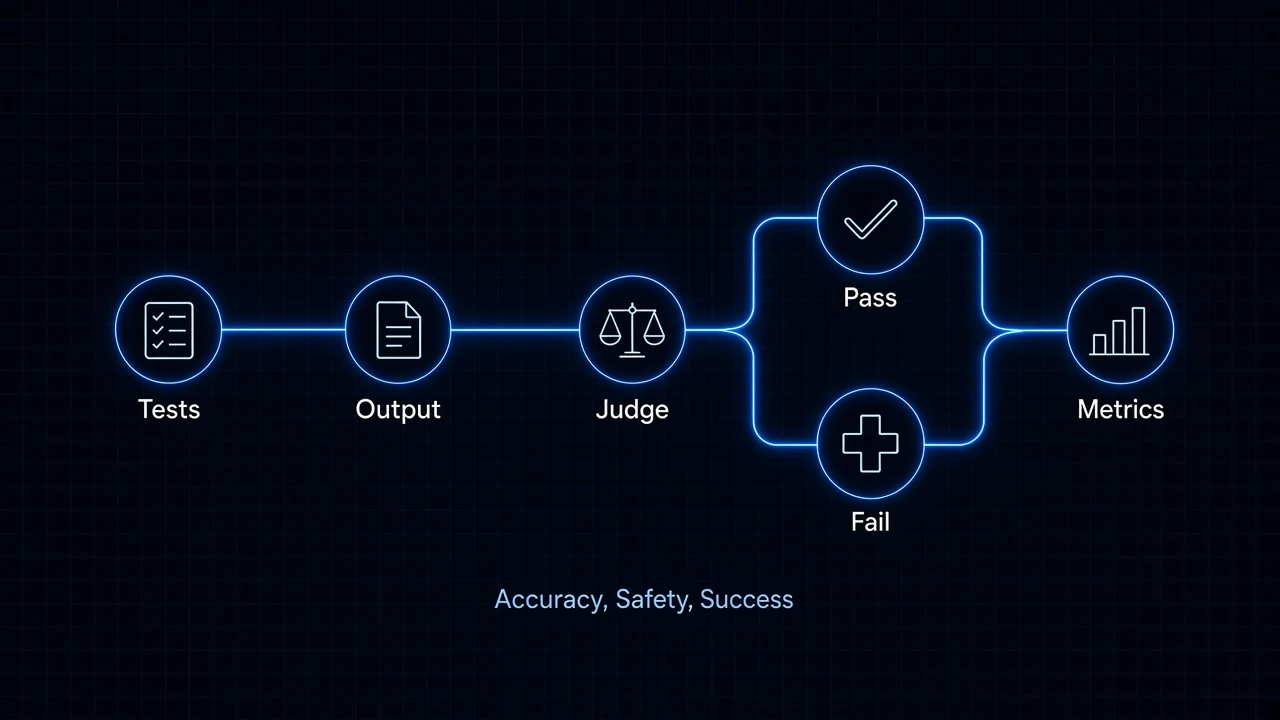
- Tests
- Output
- Judge
- Pass / fail
Why does a loop need its own quiz, not only a model bench?
A public benchmark tells you something about a model. It tells you almost nothing about a loop that plans, calls tools, observes results and decides whether to stop. The failure you care about often sits between steps: the tool was called with the wrong argument, the observation was ignored, the loop ran past the point where it should have stopped.
If you only score the final sentence, you will miss those failures. A loop eval has to look at the path as well as the answer — at least enough to say whether the agent used a tool it should not have used, or stopped for a reason you can defend.
What should a loop eval set contain?
A useful set is small, fixed and unpleasant. It should include cases the loop usually handles, cases it has already failed, and a few cases you hope it will refuse. Golden answers help when the task has a clear right output. For open tasks, a rubric is more honest than a single reference sentence.
I would also keep a slice of production-like traces, stripped of anything that should not leave the system, and label them by hand at least once. An eval built only from invented prompts will drift away from the work the loop actually does. The set should change slowly, and every addition should be justified, or you will no longer know what a movement in the score means.
| Case type | What it is for | How I judge it |
|---|---|---|
| Happy path | Work the loop should already handle | A golden answer, or a short rubric |
| Known failure | A miss you have already seen | Must fail until the fix is real |
| Should refuse | A request the loop must decline | A rule, then a person on the misses |
| Open task | Work with no single right sentence | A rubric, calibrated on a human sample |
| Production-like trace | A cleaned run from real work | A label you trust, added at least once by hand |
Who should judge the output — a model, a rule, or a person?
Rules are cheap and clear when the test is binary: did the agent call a forbidden tool, did it leave a required field empty, did it exceed the turn cap. A model-as-judge is useful for open answers, but it has to be calibrated against a human sample, or you are scoring a model with another model you have not checked.
A person should still see the failures that matter, especially safety cases. I would rather have a short rubric and a human review of the misses than a fully automatic score I cannot explain. The judge is part of the product. If you cannot say who judged a run, you cannot stand behind the number.
How do you turn a score into a ship or no-ship decision?
A metric without a threshold is a comment. Before you run the candidate, you should know what “good enough” means: which scores must not drop, which failures are blocking, and what you will do if the new version wins on fluency and loses on a safety case.
The decision also needs a baseline. Compare this loop to the last version you shipped, on the same cases, with the same judge. A jump in a score after you changed both the prompt and the test set is not a result. It is a new experiment. I have written at more length about comparing versions of a multi-agent system; the same discipline applies to a single loop, with a smaller surface.
What I measured when an eval actually gated a release
On the DILA project I have already described on this site, a retrieval system was not accepted on a demo. It was accepted against a published eval: faithfulness 0.94, relevancy 0.91, precision 0.89, recall 0.92, with 85 percent eval coverage. Those figures belong to a RAG evaluation, not to an agentic loop in isolation, and I will not relabel them. They are here because they show what a ship-or-no-ship bar looks like when it is written down.
The method for comparing multi-agent versions — layers, release gates, a harness you can rerun — is in Evaluating Multi-Agent Systems in Production. This article stays with the narrower quiz: one loop, one set, one decision.
How is this different from evaluating a multi-agent system?
A multi-agent eval has to account for coordination: who hands off to whom, whether two agents disagree, whether the merge step hides a failure. A loop eval is more modest, and that is a virtue. You can get it in place earlier, on a smaller set, and use it every time you change a stop rule or a tool description.
I would start with the loop. If you cannot say whether one agent improved, you will not be able to say whether a graph of agents improved. The two practices share a judge, a baseline and a threshold. They do not share a scope. Mixing them usually produces a score that no one can act on.
What changes once an eval can block a release?
The conversation moves. People stop asking “did it look good yesterday?” and start asking “did it clear the bar on the set we agreed?” A failed case becomes a ticket, not a story. A prompt change that helps a favourite demo and hurts the set is easier to refuse.
It also changes how you work on cost and tools. A cheaper model, a shorter context or a new MCP server can go through the same gate. If the score holds and the budget falls, you have a result. If the score falls, you have a reason to stop, even when the demo still shines.
What would I put in the first eval set this month?
Five to fifteen cases are enough to start, if they are stable. I would include two happy paths, three failures you have already seen, two requests the loop must refuse, and a couple of open tasks with a short rubric. I would freeze the set, name the judge, and write the threshold before the next prompt change.
I would also add one cleaned production-like trace, even if it is imperfect. The point of the first set is not coverage. It is to make the next argument factual: this version passed, or this version failed, on the same cases as last week. You can grow the set when a live miss is not already represented.
When is a model-as-judge a bad idea?
When the case is a hard rule, a safety limit, or a tool the agent must not call. A model-as-judge is a soft scorer. It is the wrong instrument for a binary constraint you can already write as a test. Using it there adds cost, and it can miss the failure you care about.
It is also a bad idea when you have not checked it against a human sample on your own tasks. A judge that agrees with people on a public bench can still drift on your domain. I would keep the model-as-judge for open answers, publish its agreement rate on a sample, and never let it be the only gate on a safety case.
FREQUENTLY ASKED QUESTIONS
Is a public model benchmark an eval for my loop?
No. A public bench scores a model on a shared set. A loop eval scores this loop, with its tools and stop rule, on cases that look like your work. You can use a public bench as a complement. You cannot use it as a release gate for the product.
How many cases do I need to start?
Fewer than you think, if they are stable and include known failures. A short set you rerun on every change beats a large set you never quite finish. Grow it when a production miss is not already represented, not to make the dashboard look busier.
Can a model be the only judge?
Not for the cases that can harm someone or break a policy. A model-as-judge is useful on open answers once you have checked it against a human sample. Rules should still catch hard constraints, and a person should still see blocking failures.
What if the task has no single right answer?
Use a rubric: completeness, faithfulness to sources, respect for limits, quality of the stop. Two reviewers on a sample will tell you whether the rubric is usable. A single golden sentence is the wrong tool for an open task.
How does this relate to your article on multi-agent evaluation?
That article is about comparing versions of a multi-agent system and the gates around a release. This one is the narrower quiz for a single loop. Start here if you do not yet have a set. Read the other when coordination itself is what you need to score.
RESULTS
0.94
DILA faithfulness (RAG eval)
85%
eval coverage on that project
1 set
fixed cases before a candidate run
THE CODE
KEEP READING
Figures come from validated client results and from my role at Devoteam. The projects on GitHub are public betas.