November 24, 2026 · 10 min read · Agentic AI · Multi-agent · Architecture
Subagents and Multi-Agent Systems: When to Split the Work, and How to Merge It
Several agents are not a sign of maturity. They are a split of one loop into several, with isolated context and a merge at the end. Do it when a single agent has clearly hit a limit, and not before.
Yassine Aqejjaj · HEAD OF AI · Updated on November 24, 2026
A multi-agent system is an orchestrator that delegates work to specialist agents, each with its own tools and isolated context, then merges the results. Every extra agent is another loop to trace, not a shortcut. Split a task this way only when a single agent has clearly reached a limit you can show.
What is a subagent, and what is a multi-agent system?
A subagent is a specialist with a narrower job, its own tools and, ideally, its own context window. A multi-agent system is the arrangement around it: something — usually an orchestrator — that assigns work, keeps specialists from stepping on each other, and merges what comes back into one result a person can use.
This is easy to overdress. Three chatbots in a group chat are not a system. A system has a division of labour, a rule for who may write what, and a way to combine outputs without silently dropping a contradiction. I wrote about the single loop — plan, act, observe, reflect — in my article on agentic loops. A multi-agent design is several of those loops, plus a coordination loop on top.
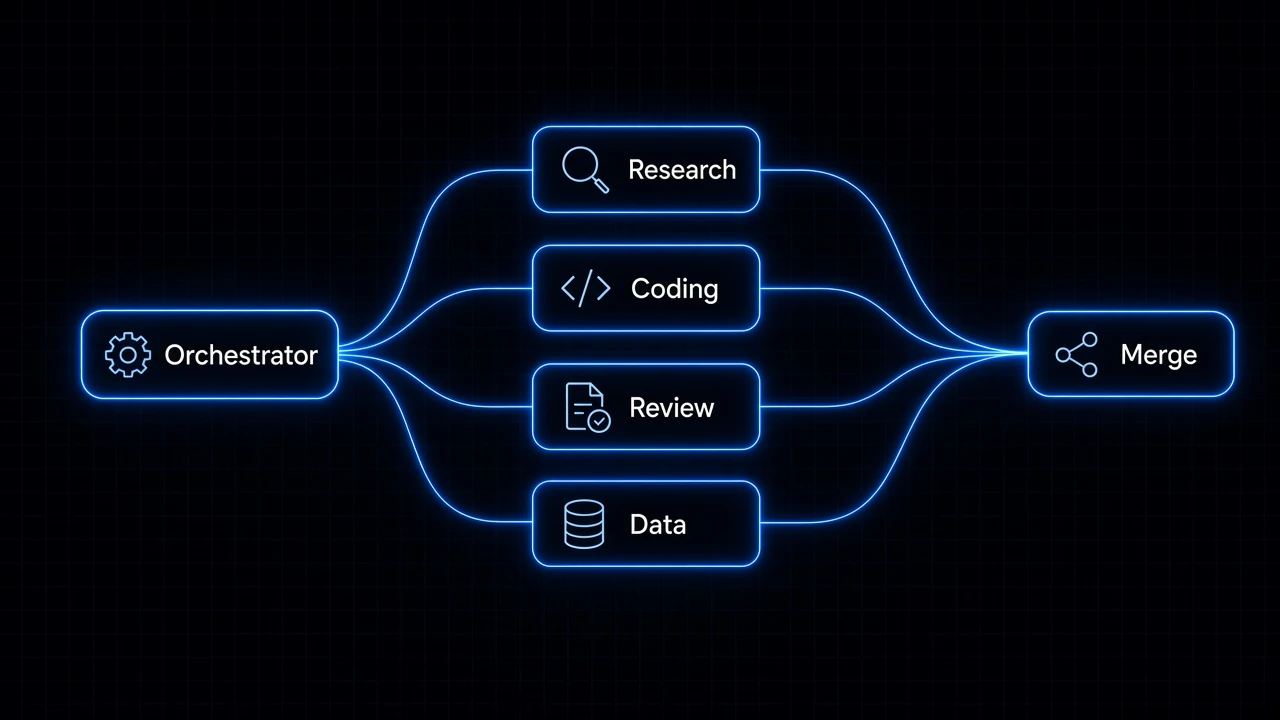
When does a single agent reach its limit?
The first limit I see is context. When one agent must hold a large tool set, a long history and two or three conflicting specialisms, it starts to mix jobs: it researches with the tone of a reviewer, or it writes before it has read. The second limit is evaluation. If you cannot say whether a failure came from research, from drafting or from a bad merge, you cannot improve the system.
A third limit is permission. A research agent that only reads and a coding agent that writes files should not share the same action surface. Isolation is not only a context trick; it is a way to keep the blast radius of a wrong call small. If none of these limits has shown up in traces, adding agents will mostly add ceremony.
Why isolate context instead of sharing everything?
Shared memory looks efficient and often is not. When every specialist can see every note, a stale or private fact travels farther than it should, and the orchestrator can no longer tell who knew what. Isolated context, with a narrow brief and only the tools for that brief, makes failures local and reviews shorter.
Isolation does not mean ignorance. The orchestrator must pass a clear assignment, and the merge must bring the useful parts back, with their provenance. I would rather have a short, signed hand-off than a shared blackboard that nobody owns. That is also why I am cautious about agents writing freely into a common store: a bad memory becomes everyone’s context.
How should the orchestrator assign work and merge results?
I prefer a supervisor that delegates to workers over a chain of informal hand-offs. A supervisor is easier to trace: one place decides who works, one place collects the result, one place applies the stop rule. Parallel fan-out is useful when specialists are truly independent, and costly when they must wait on each other or when their outputs disagree.
The merge is where quiet failures hide. If two specialists contradict each other, the orchestrator should surface the conflict, not average it into a fluent paragraph. If a specialist returns a citation, the merge should keep it. A result that cannot be attributed is a result I cannot defend.
Which failure modes are unique to several agents?
Single-agent loops already fail by wandering, calling the wrong tool or never stopping. Several agents add failures that only appear in the split and the merge. The table is the specification I would put next to the first orchestrator, not a list for later.
| Failure mode | What it looks like | Control I look for |
|---|---|---|
| Unnecessary split | Several agents do what one agent already did well, at a higher cost | A measured failure of the single agent before the split is allowed |
| Context leak | A specialist sees tools or facts it should not, and acts on them | Isolated context, a narrow tool set, and access checks at serving time |
| Lost provenance | The merged answer cannot be traced to a specialist or a source | Hand-offs that carry citations, authors and a reason |
| Silent disagreement | Two specialists conflict and the merge hides it in fluent text | A merge rule that surfaces contradictions instead of smoothing them |
| Coordination loops | Agents wait on each other, or the orchestrator never ends the job | A stop rule on the orchestrator, and timeouts on every specialist |
What have I measured when specialists work together?
On NOVA Suite, work is not handed to a single generalist. An orchestrator routes a request to specialist agents, then assembles a deliverable. The figures I can cite are published on the NOVA page and belong to Nova Agents, not to a controlled experiment that isolates “having several agents” from the rest of the design.
The published task completion rate for Nova Agents is 86%. Agent coordination success is 92%. 81% of deliverables are accepted without major revision. These numbers describe a platform in use by 800 employees, with evaluation around it. They do not prove that more agents are always better. They show what I am willing to stand behind when the split is designed, isolated and reviewed.
How is this different from choosing an orchestration framework?
A framework — a graph, a role-based team, a vendor SDK — is a way to implement the split. It is not the split itself. I compared those implementation choices in my article on agentic orchestration frameworks. The present question is prior: should you split at all, into which specialists, with which isolation and which merge rule?
I have seen teams pick a multi-agent framework first and invent roles to fill it. That is the wrong order. Write the task and the stop rule, run one agent until its failures are clear, then decide whether a specialist would close a measured gap. The framework comes last, when you know what must be coordinated.
How do you evaluate a split, not only a final answer?
A fluent merged document can hide a specialist that did nothing useful, or a merge that dropped a citation. I want scores on the orchestrator and on each worker: did the assignment match the job, did the specialist stay in its tool set, did the merge keep provenance, and did the whole run stay inside a cost and step budget?
That is why I would not use one global score as a release gate. An average that improves can still hide the scenario where the new specialist made things worse. I set out that method in my article on evaluating multi-agent systems in production. The same discipline applies here: freeze the scenarios, compare a one-agent baseline with the candidate split, and list regressions per scenario before you keep the extra agents.
What should you refuse to split?
Some tasks look complex and are still one job. A short retrieval-and-answer path, a form with a fixed set of fields, a draft that one reviewer will rewrite anyway: these rarely justify a second loop. Coordination has a cost in tokens, in latency and in the number of places a failure can hide.
I also refuse a split when nobody can name the failure of the single agent. “We want a team of agents” is not a requirement. “The single agent mixes research and writing, and the traces show the draft starts before the sources are in” is a requirement. If you cannot write that sentence, keep one agent and spend the time on tools, stop rules and evaluation.
In what order should you add subagents?
The diagram shows the whole arrangement. It does not tell you the order. This is the sequence I would follow today.
- Start with one agent, a few tools and tracing, as I argue in the agentic-loop article.
- Record where it fails: context overflow, mixed jobs, an action surface that is too wide, or an evaluation you cannot attribute.
- Add one specialist for the failure you can name, with isolated context and a narrow tool set.
- Put an orchestrator in front, with a merge rule that preserves provenance and surfaces disagreement.
- Evaluate the orchestrator and each specialist, not only the final text, before you add a third agent.
FREQUENTLY ASKED QUESTIONS
What is a subagent?
A specialist agent with a narrower job, its own tools and, ideally, an isolated context. It is called by an orchestrator, and its result is merged into a single output the user can review.
Do I need several agents to get good results?
No. Start with one agent and a few tools. Add a specialist only when a measured failure of the single agent requires it — usually context, mixed jobs, or an action surface that is too wide.
Why isolate each agent’s context?
So that a stale, private or hostile fact does not travel into every prompt, and so that a failure can be attributed to one specialist. The orchestrator should pass a brief and merge the useful parts back, with provenance.
What is the biggest risk of a multi-agent merge?
A silent disagreement: two specialists conflict and the merged text hides it. The merge should surface contradictions and keep citations, not average them into a fluent paragraph.
How do I choose a framework for this?
After you know the split, not before. I compare graphs, role-based teams and vendor SDKs in my article on agentic orchestration frameworks. The prior decision is whether to split, and how to isolate and merge.
RESULTS
86%
task completion rate (Nova Agents)
92%
agent coordination success (Nova Agents)
81%
deliverables accepted without major revision (Nova Agents)
800
employees use NOVA at Devoteam
RELATED CASE STUDY
KEEP READING
Figures come from validated client results and from my role at Devoteam. The projects on GitHub are public betas.